The HVAC-IAQ Connection: Balancing Energy Savings with Indoor Air Quality
Post-pandemic health standards have raised the stakes for indoor air quality. Learn how to optimize ventilation, filtration, and HVAC controls to improve occupant health without exploding energy budgets.
The IAQ-Energy Tension
Indoor air quality (IAQ) and energy efficiency have historically been at odds. The most effective way to improve IAQ — increasing outside air ventilation — is also the most energy-intensive, because every cubic foot of outside air must be heated, cooled, and dehumidified to match indoor conditions. For decades, facility managers optimized for energy savings by minimizing outside air, which inadvertently degraded air quality and occupant health.
The COVID-19 pandemic fundamentally shifted this calculus. Building owners and facility managers now face heightened expectations from tenants, employees, and regulators to provide measurably healthy indoor environments — while simultaneously facing pressure to reduce energy consumption and carbon emissions. Balancing these competing demands requires a strategic, data-driven approach.
Understanding Indoor Air Quality Fundamentals
IAQ is determined by several interrelated factors:
- Particulate matter (PM2.5 and PM10): Microscopic particles from dust, pollen, combustion, and industrial processes that penetrate deep into the lungs.
- Volatile Organic Compounds (VOCs): Gases emitted from building materials, furniture, cleaning products, and office equipment. Formaldehyde is a common concern in new construction and renovations.
- Carbon dioxide (CO₂): A proxy for ventilation effectiveness. Elevated CO₂ levels (above 1,000 ppm) correlate with reduced cognitive function, drowsiness, and increased airborne pathogen transmission.
- Biological contaminants: Mold, bacteria, viruses, and allergens that thrive in poorly managed humidity and ventilation systems.
- Humidity: The ideal range is 30–60%. Below 30% increases respiratory irritation and viral transmission; above 60% promotes mold growth and dust mite proliferation.
Strategy 1: Optimize Filtration
Filtration is the most energy-efficient way to remove airborne contaminants, because it cleans recirculated air without requiring additional outside air. Key considerations:
Understanding MERV Ratings
Minimum Efficiency Reporting Value (MERV) rates a filter's ability to capture particles of different sizes. For commercial buildings:
- MERV 8: Captures pollen, dust mites, and larger particles. Adequate for basic commercial buildings but insufficient for health-focused IAQ.
- MERV 13: The ASHRAE-recommended minimum for enhanced IAQ. Captures 90%+ of particles in the 1–3 micron range, including most bacteria and respiratory droplets.
- MERV 14–16: Hospital-grade filtration. Captures 95%+ of sub-micron particles but creates higher static pressure that increases fan energy.
Filtration Upgrade Considerations
- Upgrading from MERV 8 to MERV 13 can improve particle removal by 50–70% with modest energy impact
- Verify that your air handling units can accommodate the higher static pressure of upgraded filters — fan motors may need to be upsized
- Consider HEPA portable air cleaners for high-occupancy or high-risk spaces (conference rooms, lobbies, fitness centers) rather than over-filtering the entire building
- Replace filters on a pressure-drop schedule rather than a fixed calendar — this optimizes both filtration effectiveness and energy consumption
Strategy 2: Demand-Controlled Ventilation (DCV)
DCV is the single most effective strategy for balancing IAQ and energy savings. Instead of supplying a constant rate of outside air based on maximum occupancy, DCV uses CO₂ sensors to modulate outside air based on actual occupancy in real time.
A conference room designed for 50 people but occupied by 5 doesn't need the same ventilation rate. DCV reduces outside air during low-occupancy periods, saving significant heating and cooling energy, while increasing ventilation when CO₂ levels rise — ensuring air quality is never compromised.
Energy impact: DCV can reduce HVAC energy consumption by 10–30% in buildings with variable occupancy patterns, while simultaneously improving air quality during peak occupancy.
Strategy 3: Implement UV-C Disinfection
Ultraviolet-C (UV-C) germicidal irradiation installed within HVAC systems or upper-room fixtures inactivates airborne pathogens — bacteria, viruses, and mold spores — without adding static pressure or increasing outside air requirements.
- In-duct UV-C: Lamps installed inside air handling units irradiate the coil and airstream, keeping coils clean (improving heat transfer efficiency) and reducing biological contamination
- Upper-room UV-C: Fixtures mounted above occupant head level create a disinfection zone in high-risk areas (waiting rooms, lobbies, dining areas) — an approach validated by decades of tuberculosis control research
UV-C systems have low energy consumption relative to ventilation increases and require only annual lamp replacement, making them a cost-effective IAQ enhancement.
Strategy 4: Monitor and Communicate IAQ
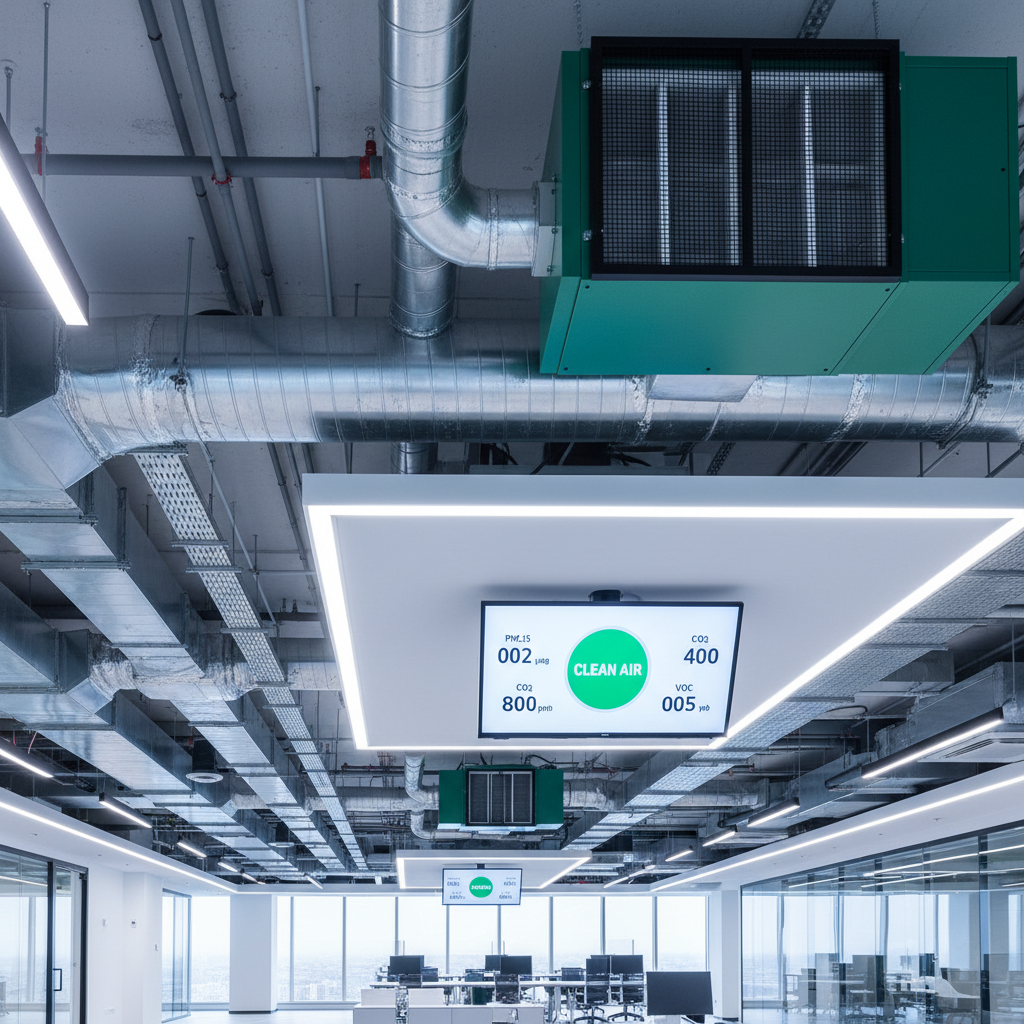
"What gets measured gets managed." Installing IAQ monitors that track CO₂, PM2.5, VOCs, temperature, and humidity provides three critical benefits:
- Data-driven operation: Real-time data allows you to adjust ventilation rates, identify problem zones, and verify that upgrades are delivering results.
- Occupant confidence: Visible IAQ displays in lobbies or common areas demonstrate your commitment to occupant health — a powerful tenant retention and marketing tool.
- Compliance documentation: As IAQ standards evolve (ASHRAE 62.1, WELL Building Standard, LEED), continuous monitoring data provides the documentation needed for certification and compliance.
Strategy 5: Seal and Balance Ductwork
Leaky ductwork is a hidden energy and IAQ problem. In typical commercial buildings, 20–30% of conditioned air leaks out of duct joints before reaching its intended destination. This forces the system to work harder, wastes energy, and can draw contaminants from wall cavities, attics, or mechanical spaces into the occupied airstream.
- Conduct a duct leakage test using a duct blaster to quantify leakage
- Seal accessible duct joints with mastic sealant or UL-listed foil tape (not standard duct tape)
- Perform air balancing to ensure each zone receives its design airflow — unbalanced systems create hot/cold spots and inconsistent air quality
Pro Tip: Find HVAC and IAQ Specialists
Optimizing the HVAC-IAQ balance requires experienced contractors who understand ventilation engineering, filtration, and building controls. Search our directory for verified commercial HVAC service providers in your area. For more facility management insights, explore our complete guide library.
Maintenance Checklist
Track and complete each task. Download a printable copy for your facility maintenance records.
Monthly Tasks
Quarterly Tasks
Semi-Annual Tasks
Annual Tasks
HVAC Services Providers
Verified companies specializing in hvac services
Frequently Asked Questions
Common questions from facility managers and building owners.
Find HVAC contractors in Your State
Browse our directory of verified HVAC contractors across all 50 states. Each state page includes provider listings, typical maintenance costs, industry insights, and a hiring checklist.