Hard Floor Care for Commercial Facilities: A Complete Maintenance Guide
From daily maintenance routines to strip-and-wax cycles, grout sealing, and surface-specific protocols — a comprehensive guide to keeping commercial hard floors looking their best while extending their service life.
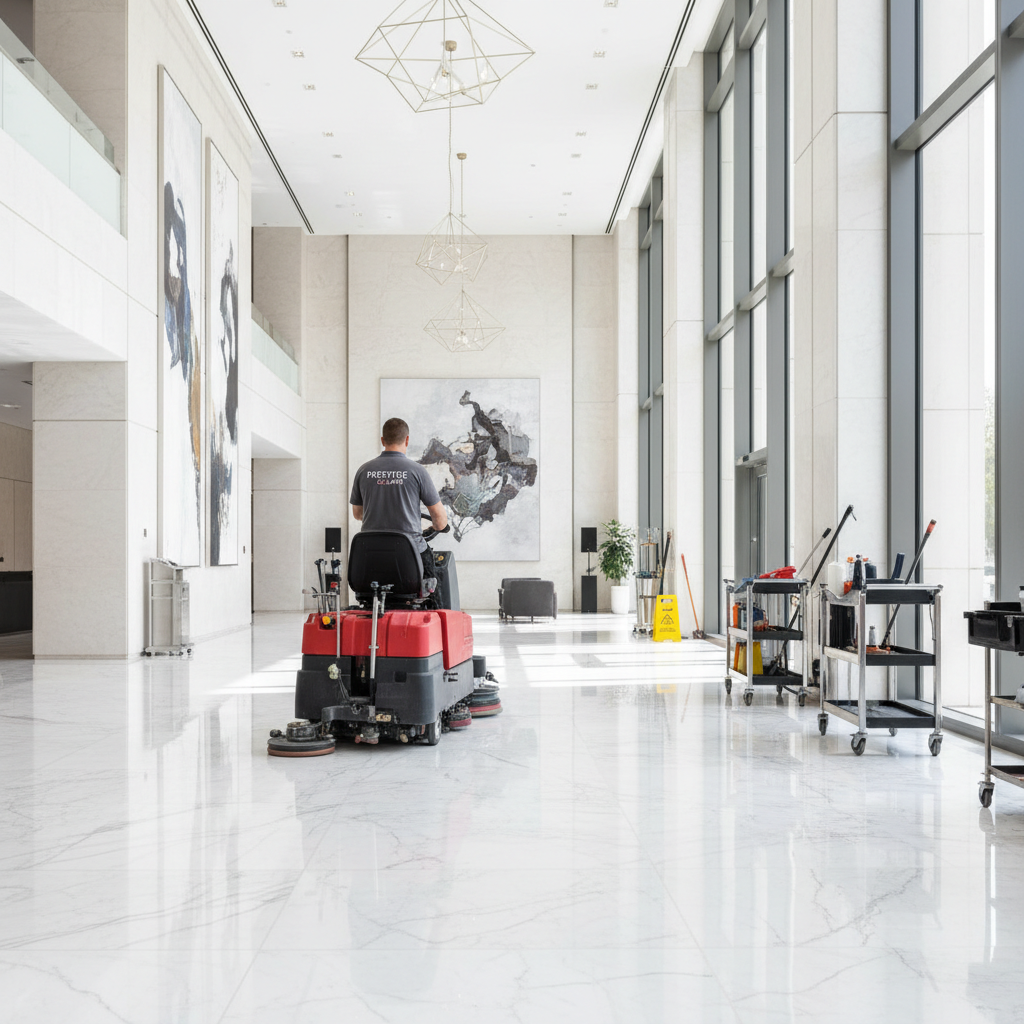
Hard Floor Care for Commercial Facilities: A Complete Maintenance Guide
Hard floors are among the most visible elements of a commercial facility — and among the most abused. High foot traffic, rolling loads, cleaning chemical abuse, and deferred maintenance combine to age floors far faster than necessary. A structured floor care program protects a significant capital asset while keeping the facility looking professional every day.
This guide covers the full spectrum of commercial hard floor types and the maintenance protocols appropriate for each, from daily sweeping to periodic restoration.
Know Your Floor Type Before You Start
The single most important rule in commercial floor care: identify the surface before selecting any chemical or procedure. Using the wrong product — or the right product on the wrong surface — can cause permanent damage. Common commercial hard floor types include:
- Vinyl Composition Tile (VCT): The workhorse of commercial flooring — schools, healthcare, retail. Porous, requires finish (wax) coats for protection. Highly customizable maintenance programs.
- Luxury Vinyl Plank/Tile (LVP/LVT): Increasingly common in modern builds. Durable wear layer but does not accept traditional floor finish. Requires no-buff or spray-buff programs specifically formulated for urethane-coated surfaces.
- Ceramic and Porcelain Tile: Extremely durable surface but grout joints are highly porous and susceptible to staining and microbial growth. Grout maintenance is the key challenge.
- Natural Stone (Marble, Granite, Travertine): Premium aesthetic, high maintenance. Acid-sensitive — never use standard neutral cleaners containing any acidic component. Requires pH-neutral or alkaline cleaners only.
- Hardwood: Rarely used in high-traffic commercial spaces but found in hospitality and executive areas. Moisture-sensitive; avoid wet mopping.
- Concrete (Polished or Epoxy-Coated): Common in warehouses, manufacturing, modern retail. Polished concrete requires periodic diamond re-polishing; epoxy coatings need chemical-compatible cleaners.
- Terrazzo: Found in older commercial buildings, schools, airports. Requires specialized crystallization or sealing programs.
The Four-Stage Floor Maintenance Model
Stage 1: Daily Maintenance
Daily maintenance prevents the accumulation of abrasive grit and soil that scratches finishes and embeds into porous surfaces. For most commercial hard floors:
- Dry dust mop or auto-scrub with clean water daily in high-traffic areas
- Damp mop spills immediately — standing liquid is the enemy of most floor types
- Maintain walk-off matting at all entries — properly sized matting (minimum 15 feet of scraping and wiping surface) removes up to 80% of incoming soil before it reaches the floor
- Inspect for damaged tiles, grout failure, or finish wear that needs escalation
Stage 2: Periodic Scrubbing and Recoating (VCT)
VCT floors require periodic machine scrubbing and recoating to maintain finish integrity. Frequency depends on traffic volume:
- Light traffic: Scrub and recoat every 90–120 days
- Medium traffic: Every 45–60 days
- Heavy traffic: Monthly or as needed based on finish wear inspection
Use a low-speed (175 RPM) floor machine with a white or red pad for scrubbing. Apply 1–2 coats of finish after scrubbing, allowing full dry time between coats. Never apply finish over dirty floors.
Stage 3: Burnishing (VCT and Compatible Finishes)
High-speed burnishing (1,500–3,000 RPM) heats the finish surface and creates a high-gloss "wet look" appearance without adding product. Burnishing extends the life of the finish layer between recoat cycles. Use a propane or electric high-speed burnisher with a matching pad (tan or white for most finishes). Burnish only clean floors — burnishing over soil embeds it permanently into the finish.
Stage 4: Strip and Refinish
Eventually, finish accumulation, yellowing, embedded soil, and scratching require complete stripping and starting fresh. Signs that stripping is needed:
- Yellowed or discolored finish that doesn't respond to scrubbing
- Finish buildup in corners and along walls while traffic lanes are worn through
- Slippery surface despite clean appearance (finish softening)
- Inability to achieve gloss through burnishing
Strip and refinish typically occurs 1–3 times per year depending on traffic. Use a low-speed machine with a black stripping pad and a diluted floor stripper. Wet the floor, allow dwell time (5–10 minutes), agitate, and remove thoroughly. Neutralize with clean water before applying new finish. Apply 3–5 coats of finish for a durable base.
Tile and Grout Care
Ceramic and porcelain tile surfaces are relatively easy to maintain, but grout joints require dedicated attention:
- Seal all grout joints annually with a penetrating silicone or epoxy grout sealer
- Use a grout brush or auto-scrubber with appropriate chemistry for periodic deep cleaning
- For heavily stained grout, alkaline degreaser applied with dwell time before scrubbing is more effective than abrasive scrubbing alone
- Address cracked or missing grout promptly — water infiltration beneath the tile causes subfloor damage and loose tiles
Natural Stone: What Not to Do
Natural stone is the floor type most frequently damaged by improper cleaning. Critical rules:
- Never use vinegar, lemon-based cleaners, or any acidic cleaner — acid etches marble and limestone permanently
- Never use bleach on natural stone — discolors and weakens the surface
- Use only pH-neutral cleaners specifically labeled for natural stone
- Seal annually with a penetrating stone sealer appropriate for the stone type
- Honing and polishing (grinding with diamond abrasives) restores etched or scratched stone — this is a specialty service requiring trained technicians
Choosing the Right Floor Care Contractor
When evaluating commercial floor care contractors, look for:
- ISSA (International Sanitary Supply Association) membership or CIMS certification — indicates commitment to professional standards
- Experience with your specific floor type — ask for references from similar facilities
- Clear written scope of work specifying frequencies, products used, and performance standards
- Proof of liability insurance and workers' compensation coverage
- Willingness to provide a test area before committing to a full-facility program
A well-executed floor care program extends the life of commercial flooring significantly — quality VCT maintained properly can last 20+ years. Deferred or improper maintenance accelerates wear, requiring costly replacement on a 5–8 year cycle instead.
Maintenance Checklist
Track and complete each task. Download a printable copy for your facility maintenance records.
Routine Inspection
Preventive Maintenance
Documentation
Frequently Asked Questions
Common questions from facility managers and building owners.
Find Facility service providers in Your State
Browse our directory of verified facility service providers across all 50 states. Each state page includes provider listings, typical maintenance costs, industry insights, and a hiring checklist.