Commercial Roof & Building Envelope Maintenance: Inspection Checklist & Cost Guide
A practical roof and building envelope maintenance guide for facility managers — covering inspection checklists, flat roof vs. membrane systems, weatherproofing, drainage, and 2026 cost benchmarks.
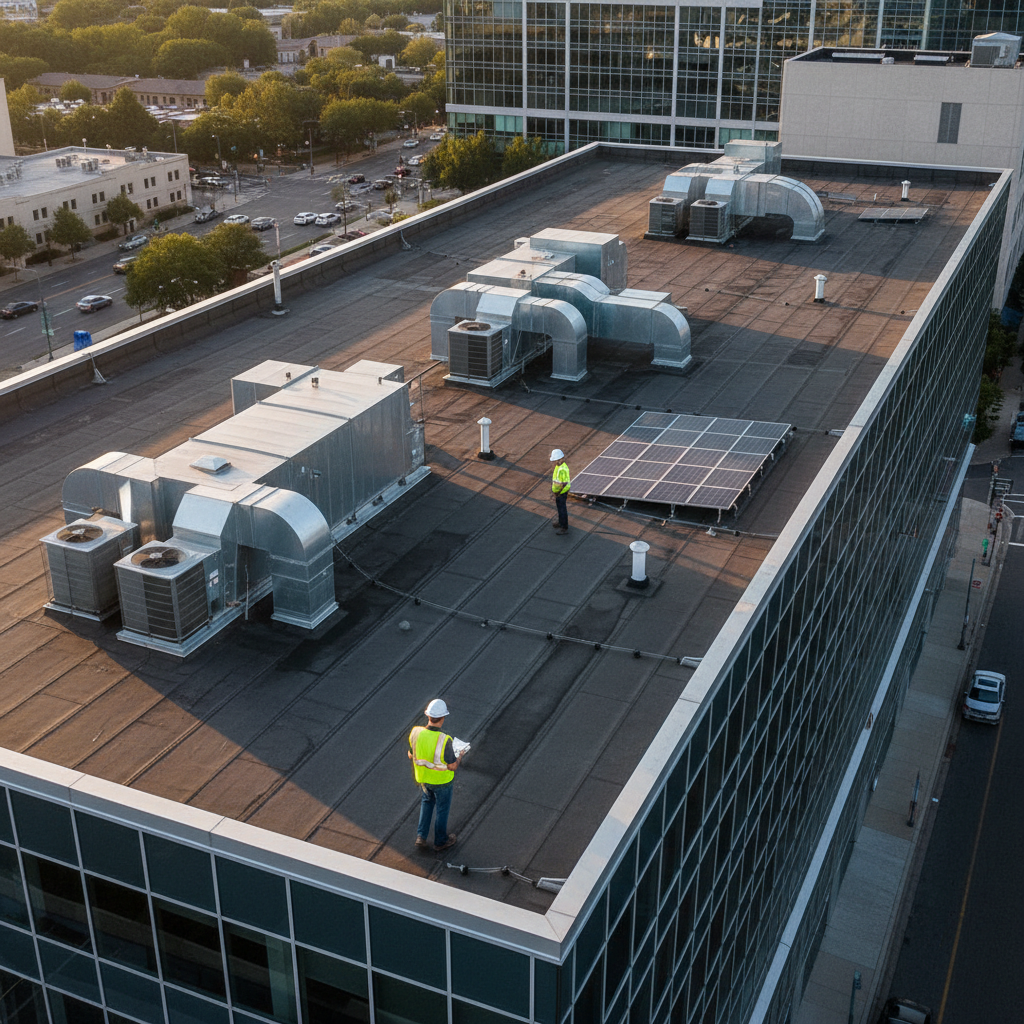
Commercial Roof & Building Envelope Maintenance: Inspection Checklist & Cost Guide
The building envelope — roof, walls, windows, doors, and foundation — is the first and most critical line of defense against water, air infiltration, and energy loss. Roofing failures alone account for more commercial insurance claims than any other building system, and water intrusion from a compromised envelope can cascade into mold, structural damage, electrical failures, and tenant disputes.
Despite being the most exposed system in a building, roofs and envelopes are frequently the most neglected. Most commercial roofs fail not from age, but from deferred maintenance — small problems (cracked caulk, blocked drains, membrane punctures) that escalate into major replacements when left unaddressed. This guide gives facility managers a practical framework to protect their investment.
After Every Major Weather Event
- Walk the roof perimeter at grade level — look for displaced flashing, fallen equipment, visible membrane damage
- Check all roof drains for blockage from storm debris
- Inspect all building corners and parapets for visible cracks or displacement
- Check interior ceilings and walls adjacent to exterior for water stains or new leaks
- Document any damage with photos for insurance purposes
Monthly Roof & Envelope Checklist
- Clear roof drains, gutters, and scuppers of leaves and debris
- Inspect HVAC equipment curbs and penetrations for membrane separation
- Check interior ceilings for new water stains after any rainfall
- Inspect roof access hatches and doors for proper sealing
- Monitor any known trouble areas or previous repair locations
Bi-Annual Roof & Envelope Inspection Checklist
Conduct formal inspections in spring and fall — ideally by a qualified roofing contractor:
- Membrane inspection: Check for blisters, splits, punctures, open seams, and UV degradation
- Flashing inspection: Inspect all base flashing, counter flashing, and cap flashing at walls, parapets, and penetrations
- Drain inspection: Verify all drains are clear, bowls are seated properly, and strainers are in place
- Penetration inspection: Check all pipes, conduits, vents, and HVAC curbs for membrane integrity
- Parapet inspection: Look for cracking, spalling, or movement in parapet walls and cap flashing
- Caulking and sealant: Inspect all exterior caulk joints at windows, doors, and expansion joints — caulk has a typical lifespan of 5–10 years
- Exterior wall inspection: Look for efflorescence (white mineral staining), cracking, displaced masonry, or signs of water infiltration
- Window and door inspection: Check glazing seals, perimeter caulking, thresholds, and weatherstripping
Annual Building Envelope Maintenance Tasks
- Formal roof inspection by licensed roofing contractor (document condition, warranty status)
- Air and water infiltration testing if occupants report drafts or condensation issues
- Infrared thermography scan to identify wet insulation and air leakage (best done in winter)
- Re-caulk all deteriorated exterior joints
- Inspect and repoint masonry mortar joints showing erosion or cracking
- Clean and seal concrete or masonry surfaces as needed
- Review roof warranty terms — most require annual inspections to remain valid
Commercial Roofing Systems: Maintenance Differences
TPO / EPDM Membrane Roofs (Most Common)
- Inspect seams annually — heat-welded TPO seams and EPDM adhesive seams are most common failure points
- Apply EPDM lap sealant to exposed seam edges every 3–5 years
- Clear membrane surface of debris and standing water
- Expected lifespan with maintenance: 20–30 years
Modified Bitumen Roofs
- Inspect granule loss and surface oxidation annually
- Apply roof coating every 5–10 years to extend lifespan
- Pay attention to laps and seams — prone to splitting in temperature extremes
- Expected lifespan with maintenance: 15–25 years
Built-Up Roofing (BUR)
- Inspect gravel surface for voids and bare spots
- Check flood coat for cracking and alligatoring
- Expected lifespan with maintenance: 20–30 years
Metal Roofs
- Inspect fasteners and sealant at penetrations and panel seams annually
- Check for rust, corrosion, and paint failure
- Clear debris from valleys and gutters
- Expected lifespan with maintenance: 30–50 years
Commercial Roofing & Envelope Maintenance Costs (2026)
- Annual roof inspection (professional): $300 – $900 depending on roof size
- Roof drain cleaning: $150 – $400 per drain (professional service)
- Minor membrane patch repair: $300 – $1,500 per repair
- Flashing repair or replacement: $500 – $3,000 depending on scope
- Re-caulking exterior joints: $500 – $3,000 depending on building size
- Infrared thermography roof scan: $500 – $2,000
- Roof coating application: $1.00 – $3.00 per sq ft installed
- Full roof replacement (TPO/EPDM): $7 – $15 per sq ft installed
- Masonry repointing: $10 – $25 per sq ft
Industry data consistently shows that every $1 spent on preventive roof maintenance saves $5–$10 in premature replacement and water damage repair costs. A 50,000 sq ft roof replacement runs $350,000–$750,000 — annual inspections at $500–$900 are among the highest-ROI maintenance activities available.
Early Warning Signs of Roof or Envelope Failure
- Water stains on interior ceilings or walls (even small ones — they indicate a larger intrusion area)
- Mold or mildew odor in top-floor spaces
- Visible daylight through roof hatches or ceiling joints
- Peeling paint or efflorescence on exterior masonry walls
- Condensation on interior window surfaces during cold weather
- Ice damming at gutters or roof edges in northern climates
- Tenant complaints about drafts or temperature inconsistency near exterior walls
How to Select a Commercial Roofing Contractor
- Verify state roofing contractor license and active insurance
- Confirm manufacturer certification for your roof system type — required for warranty work
- Ask about experience with your specific roofing membrane brand and system
- Request a written inspection report with photos, not just a verbal assessment
- Check references from comparable commercial projects in your region
- Confirm they offer ongoing PM agreements, not just reactive repair service
- Verify they will honor manufacturer warranty documentation requirements
Explore More Resources
Maintenance Checklist
Track and complete each task. Download a printable copy for your facility maintenance records.
Daily Tasks
Monthly Tasks
Quarterly Tasks
Annual Tasks
Facility Maintenance Providers
Verified companies specializing in facility maintenance services
Frequently Asked Questions
Common questions from facility managers and building owners.
Find Facility maintenance providers in Your State
Browse our directory of verified facility maintenance providers across all 50 states. Each state page includes provider listings, typical maintenance costs, industry insights, and a hiring checklist.